

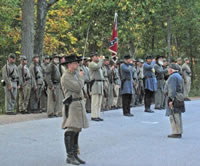
 In
1981 a handful of descendants of the 26th North Carolina Troops
embarked upon an effort to create an organization to perpetuate
the history of their ancestor’s regiment and North Carolina’s
role in the American Civil War. By 1982 these men, joined by
others with the same interests, officially formed the “Society
for the Historical Preservation of the 26th Regiment North Carolina
Troops” in Rutherfordton, North Carolina. From these humble
beginnings, the 26th NC has grown into the largest single re-enactment
unit in the state of North Carolina and one of the largest in
the nation. Our 200 Infantry members live in all regions of
the state, from the coast to the mountains and everywhere in
between. As with most Civil War re-enactment units, the men
of the 26th NC also have other portrayals. For example, when
taking part in a western theater event, where the Army of Tennessee
was present, we represent the 58th NC, which was one of four
regiments from North Carolina in that famous army. About two
times a year, our men portray a Federal regiment. This is done
because it is difficult to field enough Federal troops at some
re-enactments, thus we try and help out with the numbers. Our
Federal impression is based on the 24th Michigan Volunteers,
member of the famed Iron Brigade of the Army of the Potomac and
which faced the 26th NC during the first day’s fight at Gettysburg.
We feel it is our humble duty and honor to portray all soldiers
accurately and respectfully.
In
1981 a handful of descendants of the 26th North Carolina Troops
embarked upon an effort to create an organization to perpetuate
the history of their ancestor’s regiment and North Carolina’s
role in the American Civil War. By 1982 these men, joined by
others with the same interests, officially formed the “Society
for the Historical Preservation of the 26th Regiment North Carolina
Troops” in Rutherfordton, North Carolina. From these humble
beginnings, the 26th NC has grown into the largest single re-enactment
unit in the state of North Carolina and one of the largest in
the nation. Our 200 Infantry members live in all regions of
the state, from the coast to the mountains and everywhere in
between. As with most Civil War re-enactment units, the men
of the 26th NC also have other portrayals. For example, when
taking part in a western theater event, where the Army of Tennessee
was present, we represent the 58th NC, which was one of four
regiments from North Carolina in that famous army. About two
times a year, our men portray a Federal regiment. This is done
because it is difficult to field enough Federal troops at some
re-enactments, thus we try and help out with the numbers. Our
Federal impression is based on the 24th Michigan Volunteers,
member of the famed Iron Brigade of the Army of the Potomac and
which faced the 26th NC during the first day’s fight at Gettysburg.
We feel it is our humble duty and honor to portray all soldiers
accurately and respectfully.
Many people will ask why we participate in such an activity as re-enacting and preserving the memory of men whose lives have long since ceased. Perhaps the late Bruce Catton, author of so many volumes on the War Between the States, gave the best answer:
“We are people to whom the past is forever speaking. We listen to it because we cannot help ourselves. For the past speaks with many voices. Far out of that nowhere which is the time before we were born, men who were flesh of our flesh and bone of our bone, went through a fire and a storm to break a path for our future. We are a part of the future they died for; they are a part of the past, which brought the future. What they did – the stories they told and the songs they sang, and finally the deaths they died make up a path of our experience. We cannot cut ourselves from it. It is as real to us as something that happened last week. It is a basic part of our heritage as Americans.
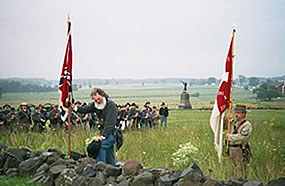 The
re-enacting component of the 26th NC has had many accomplishments
over the years. We have participated in all of the large anniversary
events since 1986 and are now in the middle of the 145th Anniversary
events. This year we will participate in the following anniversary
battles: Spotsylvania Court House and Cedar Creek. Another very
important part of our re-enactment schedule are the Living History
Programs we perform for the National Park Service, privately-owned
historical sites, and the State Historic Sites of North Carolina.
Some of the sites we have visited are Sharpsburg, Gettysburg,
Petersburg, Ft. Moultrie, Appomattox Court House, Pamplin Park,
Old Salem, Zebulon Vance Birthplace, Old NC State Capital, Ft.
Fisher, Ft. Anderson, Bentonville Battleground, and Bennett Place.
Lastly, we were honored to be a part of the funeral for the C.S.S.
Hunley crewmen in Charleston, South Carolina. Our 2009 Living
History program will be at the Cold Harbor Battlefield to commemorate
the 145th Anniversary of that battle.
The
re-enacting component of the 26th NC has had many accomplishments
over the years. We have participated in all of the large anniversary
events since 1986 and are now in the middle of the 145th Anniversary
events. This year we will participate in the following anniversary
battles: Spotsylvania Court House and Cedar Creek. Another very
important part of our re-enactment schedule are the Living History
Programs we perform for the National Park Service, privately-owned
historical sites, and the State Historic Sites of North Carolina.
Some of the sites we have visited are Sharpsburg, Gettysburg,
Petersburg, Ft. Moultrie, Appomattox Court House, Pamplin Park,
Old Salem, Zebulon Vance Birthplace, Old NC State Capital, Ft.
Fisher, Ft. Anderson, Bentonville Battleground, and Bennett Place.
Lastly, we were honored to be a part of the funeral for the C.S.S.
Hunley crewmen in Charleston, South Carolina. Our 2009 Living
History program will be at the Cold Harbor Battlefield to commemorate
the 145th Anniversary of that battle.
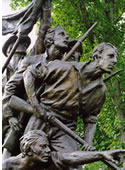 Throughout
its history, the 26th NC has helped to preserve and restore many
artifacts, grave markers and monuments. We feel it is one of
our most important responsibilities and one that we take very
seriously. Numerous letter collections and unpublished images
of the soldiers have been either transcribed and edited or researched
for publication in our historical magazine, Company
Front. Perhaps one of the most important
projects undertaken by the Regiment was the restoration of
the North Carolina Memorial at Gettysburg. The 26th NC led
the effort to raise the funds needed to properly clean and
restore the monument to its 1929 grandeur. The three-year
effort was finally concluded on July 1, 1985 when the most
beautiful
Throughout
its history, the 26th NC has helped to preserve and restore many
artifacts, grave markers and monuments. We feel it is one of
our most important responsibilities and one that we take very
seriously. Numerous letter collections and unpublished images
of the soldiers have been either transcribed and edited or researched
for publication in our historical magazine, Company
Front. Perhaps one of the most important
projects undertaken by the Regiment was the restoration of
the North Carolina Memorial at Gettysburg. The 26th NC led
the effort to raise the funds needed to properly clean and
restore the monument to its 1929 grandeur. The three-year
effort was finally concluded on July 1, 1985 when the most
beautiful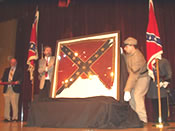 monument
at Gettysburg was re-dedicated. Twenty-four years later, the
monument still stands facing the Federal lines on Cemetery Ridge,
showing that troops from North Carolina were in the “Front Rank”
of the Confederacy. More recently, the members of the 26th NC
have formed a partnership with the North Carolina Museum of History
to raise the necessary funds to restore various Confederate Battle
Flags. Over the years we have raised the necessary money to restore
one of the original battle flags of the 26th NC, the 52nd NC,
and the 47th NC. Our 2009 Preservation project is the restoration
of the battle flag of the 58th NC.
monument
at Gettysburg was re-dedicated. Twenty-four years later, the
monument still stands facing the Federal lines on Cemetery Ridge,
showing that troops from North Carolina were in the “Front Rank”
of the Confederacy. More recently, the members of the 26th NC
have formed a partnership with the North Carolina Museum of History
to raise the necessary funds to restore various Confederate Battle
Flags. Over the years we have raised the necessary money to restore
one of the original battle flags of the 26th NC, the 52nd NC,
and the 47th NC. Our 2009 Preservation project is the restoration
of the battle flag of the 58th NC.
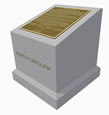
Another
important project the Regiment completed was the placement of
a monument to the men of the 26th NC at the New Bern (NC) Battlefield.
This project, costing $27,000 was completed in March 2007, making
the marker to the Regiment the first monument on the New Bern
Battlefield.
Anyone interested in exploring the world of reenacting and preserving the memory of the Confederate
soldier from North Carolina is invited to become a member of the 26th NC Regiment.
Lest We Forget.
MISSION STATEMENT

The mission of the Society for the Historical Preservation of the 26th Regiment North Carolina Troops is to accurately, positively and publicly portray, recreate, record, commemorate and memorialize the lives of North Carolina soldiers and civilians during the period of the American Civil War; especially with respect to their environment, appearance, morals, ethics, values, conduct, actions, skills, and accomplishments. We will work and cooperate to educate ourselves, our members, and the public as to the political, religious, cultural, economic, and military values, realities, attitudes and events of that time and place. We will teach by word and example in schools, at state and national historic sites, and elsewhere. We will make every effort to support the preservation of the surviving material culture of the Civil War period as well as the lands, places and structures that played a role in that historic time.

